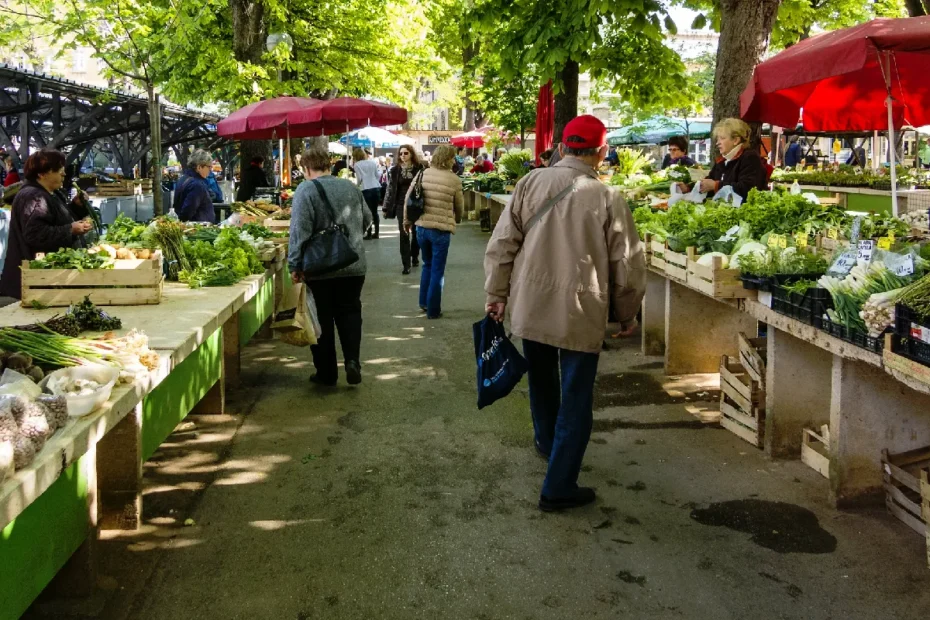
Melbourne has a reputation that it has earned honestly. Ask anyone who has spent serious time eating their way through Australia and they will tell you the same thing: Melbourne is in a different category. Not just compared to other Australian cities, but compared to most cities in the world. The food culture here runs deep, it is genuinely diverse, and it shows up in the food markets, the laneways, the suburb high streets, and the weekend gatherings that locals treat as a near-religious ritual.
For visitors who travel specifically to eat, Melbourne is one of the most rewarding destinations you can pick. The city does not have one great food market. It has several, each with its own character and its own crowd. The streets worth walking are not all in the same postcode. And the best meals are often not in restaurants at all, but at a stall run by someone who has been perfecting the same dish for twenty years.
This guide covers the food markets in Melbourne and the streets that are genuinely worth your time, with enough detail to actually help you plan the trip.
The Best Food Markets in Melbourne Worth Your Morning
Before diving into each market, it helps to know how Melbourne’s market culture works. Most food markets here are at their best between 8am and noon, and several start winding down in the early afternoon. If you are planning a market-focused day, get up early and treat the morning as the main event. Carry cash where possible. Most traders accept cards, but cash is faster and occasionally necessary at the older-style produce markets where card facilities are not universal.
1. Queen Victoria Market
No list of Melbourne food experiences starts anywhere else. Queen Victoria Market, known locally as the Queen Vic or simply the Vic Market, is the largest open-air market in the Southern Hemisphere and has been operating on the same site since 1878. That kind of continuity matters. It means the market has a culture that has developed over generations, not one that was designed by a committee trying to attract Instagram traffic.
The food hall, housed in the original sheds along the Elizabeth Street side of the market, is where most visitors spend the majority of their time. The produce here is legitimate. Greek delis with barrels of olives and buckets of feta. Butchers who have been selling the same cuts from the same families for decades. Fishmongers with a selection that reflects Melbourne’s proximity to both the Bass Strait and a genuinely multicultural city that knows how to cook seafood properly.
The deli hall in particular is worth arriving hungry for. The cooked food section at the far end offers everything from bratwurst to gyros to pastries that require immediate consumption. There is nowhere particularly elegant to sit, which is entirely the point. You eat standing up, or perched on a bollard outside, and it is better for it.
The market runs Tuesday and Thursday mornings, Friday mornings and afternoons, and all day Saturday and Sunday. Wednesday is closed. Sunday tends to draw the biggest crowds, and Saturday morning is when the produce selection is at its peak. Go early either day if you want the best of what is on offer.
2. Prahran Food Markets
About four kilometres south of the CBD, Prahran Market sits in the heart of Chapel Street and has been serving the inner south for over 150 years. Where Queen Victoria Market is sprawling and slightly chaotic in the best possible way, Prahran is more curated and noticeably quieter on a weekday morning.
The focus here is squarely on quality produce. The fruit and vegetable section is exceptional, stocked by growers who supply some of Melbourne’s better restaurants alongside the general public. The cheese selection available through the specialist traders inside the market building is one of the strongest you will find anywhere in the city.
There is also a strong prepared food culture at Prahran. Several long-running stalls sell cooked breakfast and brunch food throughout the morning, and the coffee situation is taken seriously in a way that reflects the broader Chapel Street neighbourhood. Prahran opens Tuesday, Thursday, Friday, Saturday, and Sunday. For visitors staying in South Yarra or St Kilda, it is within easy walking distance and worth building a morning around.
3. South Melbourne Food Markets
South Melbourne Market is the one that Melbourne locals tend to be most protective of. It has not been heavily promoted to tourists, which has allowed it to remain genuinely local in character. The food is excellent across almost every category, and the market has the feel of a neighbourhood institution rather than an attraction.
The dim sum stalls in the market have been a fixture for decades. The dim sims here, a distinctly Australian adaptation of the Chinese original, are a Melbourne cultural touchstone and South Melbourne Market is considered their spiritual home. They are fried, they are enormous, and if you did not grow up eating them you may need a moment to recalibrate your expectations before you appreciate them properly. Persist.
Beyond the dim sims, the market has strong Mediterranean and Middle Eastern produce traders, several excellent butchers, a very good fishmonger, and a handful of specialty food businesses including a long-running spice trader and an olive oil specialist. Open Wednesday, Friday, Saturday, and Sunday.
4. Footscray Market and Footscray Road
Footscray sits about five kilometres west of the CBD and is one of the most genuinely multicultural suburbs in Australia. The food reflects this without any compromise or softening for outside audiences. This is where Melbourne’s Vietnamese, East African, and Pacific Islander communities shop, eat, and gather, and the market and the streets around it are among the most interesting food environments in the entire city.
Footscray Market itself is primarily a produce market, and the prices are noticeably lower than anything you will find closer to the city. The Vietnamese grocers inside the market stock ingredients that are difficult to find elsewhere in Melbourne, and the prepared food stalls in and around the market building sell pho, bun bo hue, and banh mi that have no interest in adjusting to tourist expectations. They are simply good.
Footscray Road, the main commercial strip, extends this further. The Vietnamese restaurants that line the street have been feeding the local community for thirty years. The best approach is to walk the length of the strip, look through the windows, and sit down wherever looks busiest. Busy means local. Local means it is worth eating there.
5. Hardware Lane and Degraves Street
These two laneways in the CBD represent Melbourne’s famous cafe and laneway dining culture at its most concentrated. They are not hidden, and they are well known to visitors, but they belong on this list because they are genuinely good and because the experience of eating in a Melbourne laneway is something that the city does better than anywhere else in Australia.
Degraves Street runs between Flinders Lane and Flinders Street Station and is perhaps the most photographed laneway in the city. The cafes here open early and stay busy through the afternoon. The coffee is uniformly good because Melbourne cafe culture demands it. The food at the better spots leans towards all-day breakfast and simple European-style cafe food done with care.
Hardware Lane, a few blocks north near Bourke Street, is longer and has a stronger lunch and dinner presence, with a mix of Italian, Greek, and modern Australian restaurants operating out of the ground floors of buildings that were originally part of the city’s hardware trade district. At lunchtime on a weekday it fills with workers from nearby offices. In the evening it is quieter and more relaxed.
Neither laneway is a secret, but both reward visitors who sit down properly rather than just walking through. Order something, take your time, and watch how the city moves around you.
6. Dandenong Market and the Indo-Pakistani Corridor
For visitors willing to travel about 35 kilometres southeast of the city centre, the area around Dandenong and the streets off Foster Street represent one of the most extraordinary food environments in greater Melbourne. The suburb has a large South Asian, Southeast Asian, and Afghan population, and the food infrastructure that has developed around this community is remarkable.
Dandenong Market is the largest suburban market in Victoria and operates Tuesday, Friday, and Saturday. The produce hall is enormous and the prices are among the lowest in metropolitan Melbourne. The specialty food traders include Sri Lankan, Afghan, and Vietnamese grocers alongside more conventional market traders.
The streets around the market, particularly Foster Street and its side streets, are lined with South Asian restaurants, bakeries, and sweet shops that operate almost entirely for the local community. The Afghan bolani, Sri Lankan hoppers, and Pakistani nihari available within a few blocks of each other represent a standard of regional cooking that is difficult to match in a more tourist-facing environment.
A Few Practical Notes for Visitors
The city’s public transport system connects most of these locations reasonably well, but Footscray and Dandenong in particular are easier with a car or ride share if you are unfamiliar with the network.
Melbourne winters are real. The food markets in Melbourne operate year-round, but from June through August the mornings are cold and grey in a way that catches visitors from warmer climates off guard. Bring a layer you can remove once the coffee kicks in.
A market morning in Melbourne is one of the better ways to spend time in Australia, and it costs a fraction of what a restaurant meal would. That combination is increasingly rare anywhere in the world.