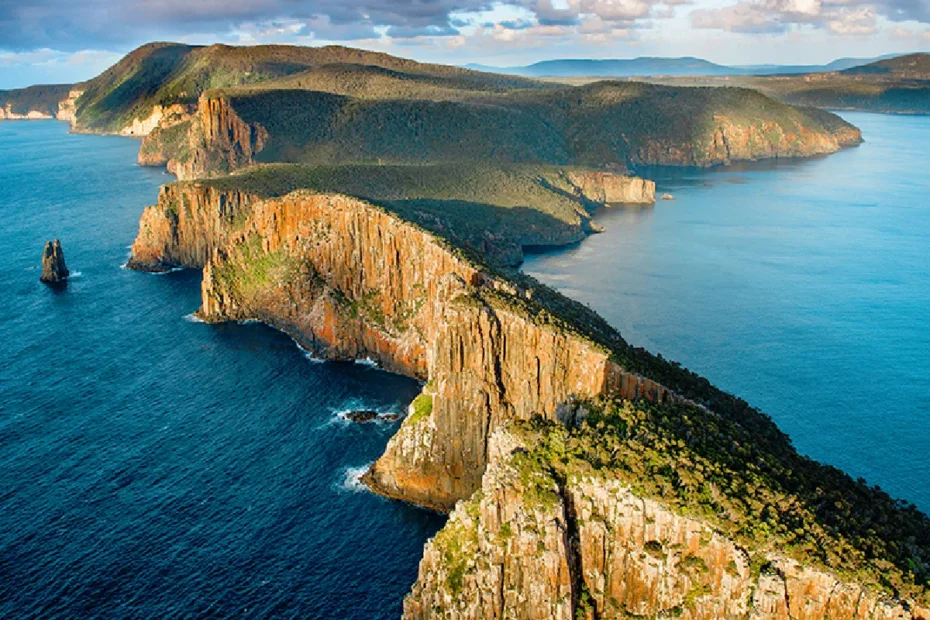
Tasmania does not announce itself loudly. It sits 240 kilometres south of the Australian mainland, separated from Victoria by the Bass Strait, and it operates at a pace and scale that is entirely its own. The island is about the size of Ireland, which gives you some sense of the distances involved, but the terrain is far more varied than that comparison suggests. In a single day you can drive from a capital city with genuinely excellent food and a thriving arts scene to a wilderness coastline where the only sounds are wind and surf and nothing has been built within fifty kilometres of where you are standing.
For international visitors planning a first trip to Australia, Tasmania is frequently underestimated or left off the itinerary entirely in favour of the mainland destinations with higher name recognition. That is a mistake that experienced Australia travellers consistently regret. The island rewards visitors who come with time and curiosity, and it offers a version of Australia that is fundamentally different from Sydney, Melbourne, or Queensland in ways that are difficult to anticipate from the outside.
This guide covers everything a first-time visitor needs to know to plan a Tasmania trip properly, from when to go and how to get there to the regions and experiences that are worth building your time around.
Visiting Tasmania: How to Get There
Tasmania is an island, which means you arrive by plane or by boat. There is no other option, and this is worth factoring into your planning from the beginning.
By air: Flights to Hobart from Melbourne take about an hour, and from Sydney about an hour and forty minutes. Flights also serve Launceston in the north of the island, which is a useful entry point if you plan to travel the island from north to south. Both Qantas and Virgin Australia operate regular services, and budget carrier Jetstar connects Melbourne to both Hobart and Launceston at significantly lower fares if you book in advance.
By ferry: The Spirit of Tasmania ferry crosses the Bass Strait overnight from Melbourne’s Station Pier to Devonport on Tasmania’s north coast. The crossing takes approximately ten to eleven hours and is the way most Australians bring their own vehicle to the island. For international visitors who have hired a car on the mainland, this option allows you to keep the same vehicle throughout your trip rather than picking up a new rental on arrival. The ferry runs year-round, though crossings during winter can be rough and the Bass Strait in a swell is not an experience everyone finds comfortable.
Visiting Tasmania: When to Go
Tasmania has four distinct seasons and the timing of your visit matters more here than in most Australian states.
Summer (December to February) is the peak season and for good reason. The days are long, temperatures in Hobart and the lowland areas sit comfortably in the mid-twenties, and the conditions for hiking, kayaking, and coastal exploration are at their best. The Overland Track and other multi-day walks in the central highlands are reliably accessible, and the summer festival calendar in Hobart, anchored by the Taste of Tasmania food festival over New Year, makes the city particularly lively. Book accommodation well ahead for January visits as the island fills with mainland Australians on holiday.
Autumn (March to May) is when Tasmania shows a different kind of beauty. The deciduous trees planted by early European settlers turn through the Derwent Valley and in the gardens of historic properties like Entally House and Brickendon Estate. The crowds thin noticeably after Easter, the light takes on a quality that photographers chase, and the cool nights make being inside in a warm pub or restaurant feel genuinely satisfying.
Winter (June to August) is cold, wet, and quiet, and some visitors find it exactly what they came for. Dark Mofo, Hobart’s midwinter arts and culture festival, runs through June and transforms the city in a way that draws visitors specifically for the occasion. Outside of festival periods, winter in Tasmania is for people who want the wilderness largely to themselves and are comfortable with short days, changeable weather, and the need for proper cold-weather gear.
Spring (September to November) brings the wildflowers and the improving weather, and it is increasingly popular with visitors who want the accessibility of summer without the crowds. The Overland Track opens for the season in late October, and the period from mid-October through November is a genuine sweet spot for hiking and wildlife watching.
Hobart
Hobart is the capital and the entry point for most international visitors, and it consistently surprises people who arrive expecting a quiet, provincial town. The city has a genuine cultural life built around food, art, and its deep maritime history, and MONA, the Museum of Old and New Art, has transformed it into an international destination in its own right since opening in 2011.
MONA sits about twelve kilometres north of the city centre on a peninsula in the Derwent River and is reached most pleasantly by the MONA ROMA ferry from the Brooke Street Pier. The museum is built into the sandstone cliff face and extends underground through several levels. The collection is confronting, deliberately provocative, and frequently extraordinary. It was funded and curated by gambler and mathematician David Walsh, and it reflects his particular obsessions with death, sex, and the nature of art in a way that makes it unlike any museum most visitors will have encountered. Allocate at least half a day, and consider staying for lunch at the on-site restaurant, which takes the same approach to food that the museum takes to art.
Salamanca Place is the historic waterfront precinct of sandstone warehouses that now house galleries, restaurants, and bars along the edge of Sullivan’s Cove. The Saturday morning Salamanca Market is one of the better produce and craft markets in Australia, and it draws a genuinely local crowd alongside the tourists. The streets behind Salamanca, particularly Battery Point, are worth an hour of walking for the colonial-era architecture and the view back over the harbour.
The waterfront and Constitution Dock is where the Sydney to Hobart yacht race finishes each year on December 28, and watching the boats arrive after the 1,170-kilometre ocean crossing from Sydney is one of the more atmospheric sporting spectacles in Australian summer. Even outside of race season the dock area is worth visiting for the floating fish punts that sell fresh fish and chips directly off the boat.
The Tasman Peninsula
About an hour’s drive southeast of Hobart, the Tasman Peninsula is one of the most scenically dramatic stretches of coastline in Australia. The sea cliffs along the eastern face of the peninsula are among the tallest in the Southern Hemisphere, rising in places to over 300 metres directly from the ocean, and the walking tracks that run along the clifftops give access to views that are genuinely difficult to process at first.
Port Arthur is the primary historical destination on the peninsula, a former convict settlement that operated between 1833 and 1877 and is now a UNESCO World Heritage Site. The site is extensive and well interpreted, and the guided ghost tour that runs after dark has a legitimate claim to being genuinely unsettling in a way that daylight visits do not prepare you for. Allow at least half a day for Port Arthur. A full day is better if you want to take the harbour cruise and explore the outlying ruins.
The Three Capes Track is a four-day guided or independent walk that connects Cape Raoul, Cape Pillar, and Cape Hauy along the cliff edge of the peninsula. It is one of the premier multi-day walks in Australia and the infrastructure along the route, purpose-built huts with composting toilets and rainwater collection, is among the best on any walking track in the country. Bookings are managed through Parks Tasmania and fill well in advance for the summer season.
Freycinet National Park and the East Coast
The east coast of Tasmania between Hobart and St Helens is one of the most consistently beautiful stretches of road in the country. The highway passes through fishing villages, wine regions, and national park land with a regularity that makes stopping frequently almost unavoidable.
Freycinet National Park is the centrepiece of the east coast and the location of Wineglass Bay, which consistently appears on lists of the world’s best beaches. The lookout over Wineglass Bay from the saddle between the Hazards peaks is a 45-minute walk from the car park and is the most visited viewpoint in Tasmania. The beach itself requires a further descent of about 30 minutes each way and is worth every step. The sand is white, the water is the kind of clear blue that looks artificially enhanced in photographs, and the pink granite of the surrounding mountains gives the whole scene a colour palette that feels almost designed.
Saffire Freycinet, the luxury lodge at the entrance to the national park, is worth mentioning for visitors for whom accommodation is part of the experience. The lodge has views across Great Oyster Bay toward the Hazards and an oyster experience at its own lease that is one of the more memorable food experiences on the island.
The Cradle Mountain Region
Cradle Mountain sits in the central highlands about two and a half hours north of Hobart and is the most iconic natural landscape in Tasmania. The mountain, reflected in Dove Lake at its base, is the image that most people associate with the island before they arrive, and the reality is as good as the photographs suggest.
The Dove Lake Circuit, a six-kilometre walk around the lake with the mountain above and the buttongrass moorland on the far shore, takes about two and a half hours at a comfortable pace and is accessible to anyone with a reasonable level of fitness. It is the walk that most visitors do, and it is the right one to prioritise if your time is limited.
The full Overland Track begins at Cradle Mountain and is covered in detail in the Outdoor and Adventure section of this site. For visitors who want the highland landscape without the commitment of a multi-day walk, the shorter trails in the Cradle Mountain day visitor area give access to alpine lakes, ancient pencil pine forests, and wombat and wallaby sightings that are almost guaranteed at dusk.
The Cradle Mountain Lodge, the main accommodation complex at the park entrance, offers a range of cabin styles from budget to premium and is the most convenient base for exploring the area. Book well ahead for summer and school holiday periods.
The Huon Valley and Southwest Wilderness
South of Hobart, the Huon Valley is Tasmania’s apple growing heartland and one of the quieter parts of the island that first-time visitors often miss. The valley towns of Huonville, Geeveston, and Dover are working agricultural communities with good food, cider houses, and access to the edges of the Southwest Wilderness, one of the largest temperate wilderness areas on Earth.
The Southwest National Park covers over 600,000 hectares and is almost entirely roadless. The only practical way to experience the deep southwest is by light plane, by sea kayak from Cockle Creek, or by walking tracks that require serious multi-day expedition planning. For most visitors the accessible version of the southwest is the drive to Cockle Creek, the southernmost point reachable by road in Australia, where a short walk brings you to a bay of extraordinary stillness with the wilderness stretching away to the horizon in every direction.
Getting Around Tasmania
A hire car is the only practical way to explore Tasmania as a first-time visitor. Public transport between the major towns exists but is infrequent and does not serve the national parks or coastal areas where the most significant experiences are. Budget for a rental car from day one and plan your itinerary around driving distances, which are deceptive on a map. The roads through the highlands and along the coast are narrower, slower, and more winding than mainland highways, and the distances between sights take longer to cover than the kilometres alone suggest.
A week is the minimum to see Hobart, the Tasman Peninsula, the east coast, and Cradle Mountain at a reasonable pace. Two weeks allows you to add the northwest coast, the Huon Valley, and additional time in the wilderness areas that the island does genuinely better than anywhere else in Australia.
Tasmania is the part of Australia that rewards visitors who slow down more than anywhere else in the country. The island has a density of worthwhile experiences per square kilometre that is extraordinary, and the mistake most first-time visitors make is trying to cover too much ground rather than staying longer in the places that matter most.